Something in the Air

January 25, 2026:
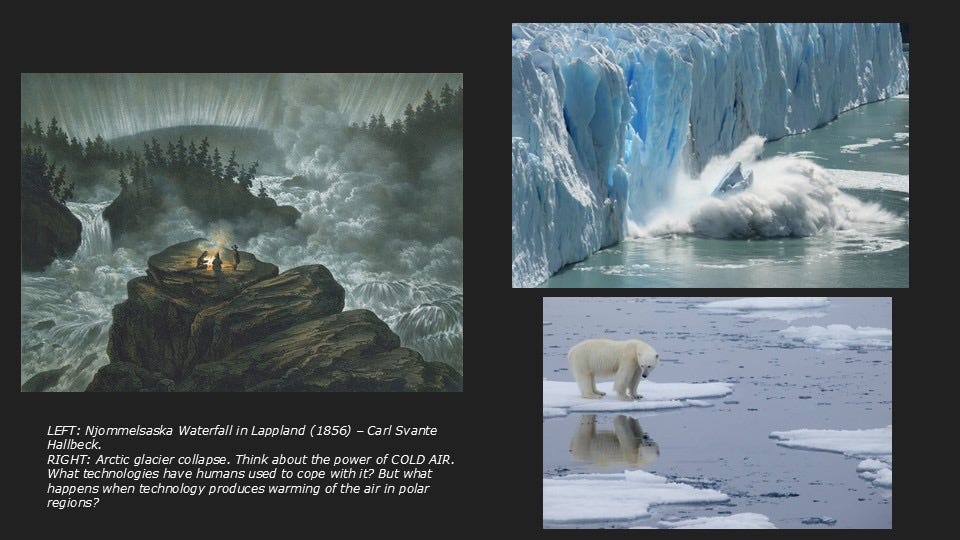
Carl Svante Hallbeck’s Njommelsaska Waterfall in Lappland depicts a scene of the sublime- a philosophical term that, as the professor in our first lecture put it , relates to the “alienation of the spirit.” The term arises in popularity from the Romantic period, the period in which Hallbeck’s painting has been made. Sublime as a philosophical understanding was reflected within nature’s “power to transform the self” (The MIT Press Reader, 2021) and taps into the parts of our psyche that are both experiencing horror and bliss. When compared to the provided images of glacial ice melting and a polar bear finding itself trapped on an ice floe, there are similarities both in composition and in material danger, whether fabricated in oil or living and with real consequence.
The contrasted difference lies here at the fabric of reality. Within Hallbeck’s landscape, he is depicting a real waterfall and its vast intensity from a position of relative safety behind a canvas. The piece was created during a time period in which rapid industrial revolution had not yet affected the flow of the Lappland falls. Meanwhile, the photograph of the arctic glacier collapse reveals both a progression in technology and an increase in evidence of massive ecological change. The unnamed photographer is harnessing photographic technology to bear witness to the arctic apocalypse. It is possible to assume that the type of people who have access to travel resources to the arctic are scientists and those who are working alongside scientists for other research or creative purposes. It is uncertain who else would be the audience for a diptych piece such as these photos, but it is safe to say that the general public was meant to witness both examples. Either could be argued for the general purpose of documenting the grandiose and ever changing nature of the world in which we live in. Both also serve as an artistic reference to how the elements are connected; water evaporating and becoming air particles that collide with light particles to display the borealis in Lappaland, and the warming of the air affecting the glacial structures that many species call home. Under the surface, each image evokes more terror than bliss. The cold air serves as a danger that the party at Lappaland is shown to be shielding themselves from, by the fire. Comparatively, the polar bear is put in danger due to the warming of the air- or more accurately the warming of its environment. Displaying these images as a triptych evokes a greater depth of the consequences that come from our actions as an industrial culture.
Citation:
Morely, S. (2021, March 21). A short history of the sublime. The MIT Press Reader. https://thereader.mitpress.mit.edu/a-short-history-of-the-sublime/